The Other Hand at the Machine: Left-Handed Sewing That Feels Natural in Beccles
Photo: Made by The Industrial Education Association, Public domain, via Wikimedia Commons
Walk into most sewing classes in Beccles and you will notice the room is set up for right-handed sewists. Scissors on the right, seam guides on the right, the person next to you pinning happily from right to left. If you are left-handed, none of that is a disaster. It just means you spend the first ten minutes rearranging the furniture — and the next ten wondering why the guidebook keeps saying simply hold the fabric with your left hand when your left hand is already busy doing something else.
Sewing is not a handedness contest. It is a set of small physical habits, and habits can be rebuilt. Whether you are cutting out your first tote bag at the kitchen table or tackling a coat alteration before the cold really settles in, here are the adjustments that make a left-handed sewing life feel less like a workaround and more like a proper way of working.
The machine is not against you
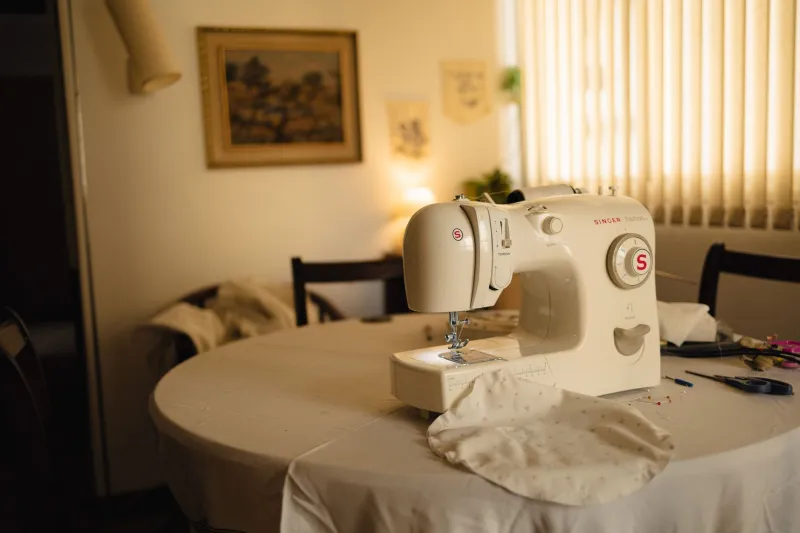
Most domestic machines are ambidextrous in theory and right-handed in practice. The needle goes up and down, the feed dogs pull the fabric back, and the thread path has a direction that may feel backwards. You do not need a special left-handed machine — they are rare, expensive and not necessary. What you need is a routine.
Thread with the machine off, the needle up and the presser foot up. If the path runs from right to left, turn the handwheel towards you and follow the manual rather than memory. Use the built-in needle threader; if yours is fiddly, a standalone needle threader and a pair of tweezers live in a small pot beside the machine. Keep the manual open at the threading page for the first few weeks. There is no prize for doing it from memory.
Bobbin winding is often on the right-hand side. Lefties can still wind a bobbin neatly: hold the thread tail with your right hand, guide it through the tension disc with your left, and keep the spool pin clear. Wind three or four bobbins before a project so you are not stopping every seam.
The biggest everyday annoyance is the seam allowance guide. Most needle plates have markings to the right of the needle, which suits sewists who keep the fabric bulk to their left. If you prefer the bulk on your right, ignore the markings and make your own guide. A strip of low-tack masking tape on the left of the needle plate, placed at 1.5cm from the needle, gives your eye something to follow. A magnetic seam guide can also be moved to the left side on many machines. Test on scrap first.
Tools that respect your dominant hand
Left-handed scissors are not a luxury. They are the difference between cutting fabric and chewing it. Buy a proper pair and hide them. Label them. If you share a sewing table, a ribbon tied to the handle is a polite but firm signal.
Rotary cutters are mostly ambidextrous, but the safety guard can be awkward. Practise opening and closing it with your left hand while the blade is retracted. Left-handed rotary cutters exist; if you cut a lot, try one before buying. A large cutting mat and a long ruler will do more for your comfort than any gadget.
Seam rippers are another small tool where handedness shows up. Some have a left-handed version; if not, hold the ripper so the small ball sits on the fabric side and pull away from the seam. A pair of embroidery scissors with a fine point is often quicker for unpicking than a ripper.
Pins: pin from left to right if that feels natural. There is no law that says pins must point one way. Just keep the sharp ends away from the needle and remove them before they reach the presser foot.
Ironing matters too. Set the board so the cord falls away from your working hand. A left-hander often reaches across the iron; move the board or use a cordless iron if you have one. Pressing is half of sewing, and a dragging cord makes every press feel like a tug-of-war.
Patterns, cutting and the mirror trap
Here is the good news: clothes are not handed. A left-handed person wears a right-handed pattern exactly the same way as anyone else. Do not mirror pattern pieces unless the design is deliberately asymmetric and you want to reverse it. The sleeve is not going to know which hand you use.
Cutting out is where lefties lose time. Lay the pattern so you can cut with your left hand without reaching across the table. For long straight edges, walk around the table rather than twisting. If you use a rotary cutter, place the mat so your left hand has room to move and hold the ruler with your right. Rotate the mat rather than the fabric when you need a new angle.
Marking is easier with the right setup. Use a water-soluble pen or chalk in your left hand and a ruler held steady with your right. If you are tracing a pattern, tape the pattern down so it does not shift while your left hand does the tracing.
A left-handed hand-sewing kit
Thimble on the left middle finger, not the right. If you have been trying to wear a right-handed thimble, it will feel like a tiny punishment. Buy a thimble that fits the finger you actually use. Most needles are symmetrical, so you can ignore left-handed needle labels unless you are buying a specialist tool.
A tailor's awl, a pair of small snips and a needle book are worth keeping on your left side of the machine. The goal is not to make a mirror-image sewing room; it is to stop reaching across your body every thirty seconds.
Local support and class tips
Beccles is a small town with a decent amount of sewing knowledge in it. Ask at the library noticeboard, the fabric shop or the local sewing group. If you are booking a class at the public hall or a workshop in the Waveney Valley, mention that you are left-handed when you book. A good tutor will seat you at the end of a bench with clear space on your dominant side and hand you the left-handed scissors before you have to ask.
Beccles Sewing's own community pages are a good place to ask for a left-handed buddy. There is no need to make it a big thing. A five-minute conversation about which way you pin is often enough to save a whole afternoon of quiet frustration.
Start small, finish something
Pick a project that does not demand fitting: an envelope cushion, a simple tote, a drawstring bag for the reusable coffee cup. Use a sturdy cotton from your stash. The point is to practise the left-handed setup on something that does not matter if it goes slightly wonky. Then, when you tackle a hem or a zip, the machine already feels like yours.
Left-handed sewing is not a niche hobby. It is just sewing with your own body in mind. Set up the table, move the guide, buy the scissors and let the right-handed guidebooks say what they like. In Beccles, on the Suffolk side of the Waveney, we can make a quiet little space where the other hand gets to lead.